But managing effective C-suite succession planning is challenging no matter where you are in the world. Consider:
- Each company is unique, so there is no one-size-fits-all approach. The maturity and scale of the business, the market(s) in which the company operates, the industry’s talent ebbs and flows, and the specific expertise needed based on the function or sector all impact succession needs.
-
It takes years for succession plans to bear fruit, but just an instant to derail them. A surprise departure of a key leader, a sudden need to dramatically cut labor costs or an opportune M&A event can reduce succession options. Similarly, a shift in the company strategy or the appointment of a new board, CEO or CHRO with different priorities will impact succession strategies and pipelines.
- Loose definitions of “high potential” make it hard to identify the best talent early and invest in their development. Decisions about who is high potential often are based on managerial recommendations rather than objective assessments of leaders’ capacity to stretch into more complex and senior roles.
- Risk aversion can keep organizations from providing high-potential leaders with important development experiences. A check-the-box mentality, reluctance to make bold developmental moves and overreliance on experience over potential (“have they done this job?”) constrains the talent pipeline, especially talent from non-traditional backgrounds.
- When it comes to key people decisions, emotions are a wild card. Even the best succession planning efforts are fraught with emotion. Because the human element cannot be underestimated, it is important to drive a thoughtful process grounded in objective criteria and the company strategy, bringing key stakeholders along and avoiding rushed timelines.
Increasing business and talent complexity require organizations to think more creatively about how to develop C-suite leaders of the future. To do so, companies should approach C-suite succession with multirole, multi-individual and even multigenerational lenses. This means playing “4D organizational chess,” and putting in place a system and culture where talent is truly embedded into business strategy.
Here is our advice for doing C-suite succession planning well.
The six rules for C-suite succession
-
Make C-suite succession an “at-the-top” responsibility
-
Succession plan based on the talent identity of your company, function and role
-
Create success profiles before discussing individuals, not the other way around
-
Be strategic by playing succession “chess”
-
Have a rigorous system to identify, develop, deploy and showcase high-potential talent
-
Make the hard decisions that put the organization’s needs first
A guide to excelling at C-suite succession planning
1. Make C-suite succession an “at-the-top” responsibility
C-suite succession is hard work, requiring consistent attention and commitment. It won’t happen unless the CEO and board set the tone and hold senior leadership accountable for developing strong benches. The CHRO then plays a critical role in operationalizing the succession planning effort.
The CHRO needs to be innovative and a good thought partner to the CEO, but the CEO drives the agenda.”
KELLY TULLIER
vice chair and chief people and corporate affairs officer,
Visa
“It has to start with the CEO,” said Kelly Tullier, vice chair and chief people and corporate affairs officer at Visa. “If the CEO doesn’t champion it, the CHRO can’t move the needle. The CHRO needs to be innovative and a good thought partner to the CEO, but the CEO drives the agenda.”
The most effective companies set the expectation that succession planning excellence is a leadership imperative and use carrots and sticks to drive outcomes. “When you take your focus off it, people can very quickly be distracted by the business issue of the day. So it really does take commitment, diligence, focus and leaders showing up, asking questions and demonstrating the importance of the process,” said Sadie Stern, executive vice president and CHRO of Dexcom.
2. Succession plan based on the talent identity of your company, function and role
With succession planning established as a priority, organizations should make sure they understand their talent identity. Are they:
- A promote-from-within organization prioritizing development of a robust pipeline of internal candidates for all key roles, including their feeder roles — such as large companies with many business units and talent “academies” with long histories and strong cultures?
-
A hire-from-outside organization leaning toward external recruitment — typically companies that are scaling or approaching new phases of growth, often small and mid-sized companies?
- A hybrid organization that both promotes leaders from within and selectively recruits from outside — such as organizations that prioritize internal succession for roles such as CFO, but tap external talent to level-up expertise in areas like technology?
We’re regularly thinking about what we do if somebody walked out the door tomorrow: How would we structure the organization? Who would be ready to step in?”
SADIE STERN
EXECUTIVE VICE PRESIDENT AND CHRO,
DEXCOM
Large companies with many business units and leadership roles can embrace a systematic succession process in which talent frameworks, career paths and critical roles are well defined, and talent conversations take place at least once or twice a year and are communicated to the board. Companies like GE, Danaher and P&G are examples of well-known talent factories where key talent moves around to gain deep and broad experience as they mature in their career.
Earlier- or mid-stage growth companies with evolving workforces may have to take a more adaptive and pragmatic approach to succession planning. At Dexcom, for example, ongoing scenario planning for emergency succession helps drive longer-term leadership development, said Dexcom’s Stern. “We’re regularly thinking about what we do if somebody walked out the door tomorrow: How would we structure the organization? Who would be ready to step in?” she said. “Those conversations then feed into the development and the exposure of the executives, which may lead us to change someone’s responsibilities, projects or oversight.”
Other considerations can impact your talent identity. For example, many companies operate in geographies or sectors requiring certain technical, linguistic or cultural backgrounds. Meanwhile, some family businesses require the CEO to be a family member, meaning family members must be in key development roles. All these factors require thoughtfulness and rigor given the company context.
The talent identity exercise applies to functions and even roles. In many industries, P&L leaders tend to be promoted from within to get exposure to different business units. At the same time, functional leaders in the same company may be more likely to be hired from outside due to the transferability of skill sets. However, in specialized sectors, companies may want even functional executives to be promoted from within. For example, in a tech company that we work with, there is strong pressure to ensure an internally promoted CFO due to the organization’s unique competitive positioning, as any external hire would face a very steep learning curve.
3. Create success profiles before discussing individuals, not the other way around
Organizations often launch annual talent planning processes with an assumptive understanding of the criteria for the role and spend most of their time discussing individuals and moves. Instead, leadership should ensure there is clarity around the success profile of each critical role, that it is up to date and aligned to the company strategy or value creation thesis. Only by doing so is an organization equipped with the blueprint to properly identify and develop people with the attributes relevant for the future needs of the business.
The CEO and CHRO, with the support of their board for appropriate roles, should ask contextual questions when creating success profiles, such as:
- What are our industry dynamics, and what threats and opportunities do we see for the business going forward? What is the job to be done through the CXO?
-
Who do we compete with for talent? What companies, sectors or functions does this role typically get talent from?
- How does the CXO complement the strengths and weaknesses of the CEO and the executive team?
- What is the current culture of CXO’s team, and what kind of culture does this team need to help achieve the overall business strategy?
- Given the above, what leadership attributes must they demonstrate, and what ideal experiences prepare them for day one?
Subsequently, when company contexts or strategies evolve, success profiles must also change, paving the way for succession plans to adapt. Imagine a company that completes a major acquisition, doubling in size and scale. The capabilities, experiences and mindsets needed in key roles are now drastically different, requiring a review of future leadership criteria.
4. Be strategic by playing succession “chess”
Succession planning should be multirole and multiscenario, including plans for emergency and longer timeframes. Further, good succession planning should be done at the individual role and executive team levels by considering the optimal mix of perspectives and backgrounds, including what would complement the CEO’s strengths and weaknesses.
When playing succession chess, companies should be thinking dynamically about individuals, roles and organization design. High-potential and high-performing talent can often be deployed into multiple roles, different roles can be suitable for a variety of talent profiles, and sometimes organizational structures should be adapted for talent needs.
Scenario planning for different time horizons — emergency, accelerated and planned — is important as well. An emergency successor is often someone who already has all the skills and experiences to “keep the lights on” on an interim basis but who may not have all the attributes fulfill the mandate longer term. The planned successor(s) would be ready in your envisioned timeframe but would have gaps if appointed tomorrow. The accelerated plan may involve a creative solution.
When playing succession chess, companies should be thinking dynamically about individuals, roles and organization design.
The longer the succession horizon, the more important it is to scenario plan. An imminent succession is straightforward, but if the incumbent may not transition for 5 to 7 years, it is not clear where the organization will be at that point. This requires the development of multiple success profiles and talent options.
Then there is the question of sequencing. A one-off succession is not difficult to execute, but successive successions require extra thoughtfulness. In such cases, leadership should consider which transition should happen first to ensure business continuity and optimize future leaders’ success. In one client example, a company sequenced CFO and CHRO successions before and after its CEO transition, respectively, connecting dots across all three situations to avoid disruptions to its value-creation plans. In cases where no internal option is quite ready, flexible organization design can create new options. In one example we’re familiar with, a company without a ready-now chief technology officer (CTO) split the technology organization into two, each headed by a succession candidate. After three years, one of the leaders was selected as enterprise CTO and the tech organizations were reintegrated.
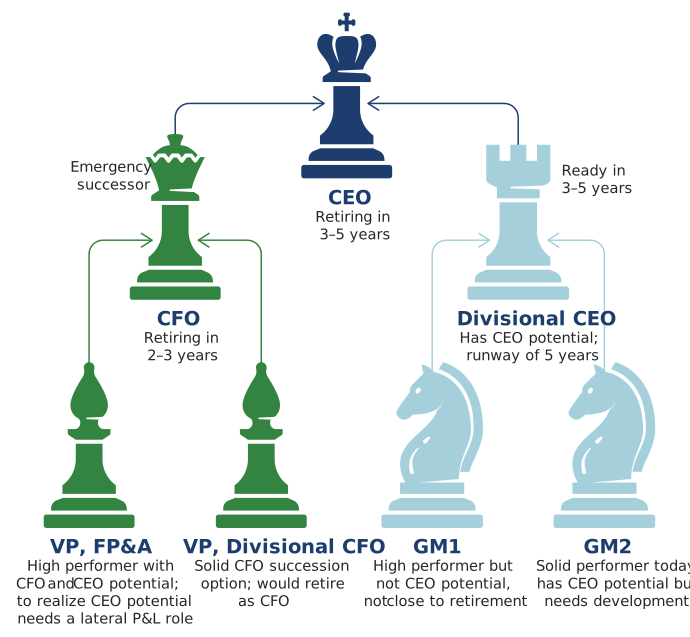
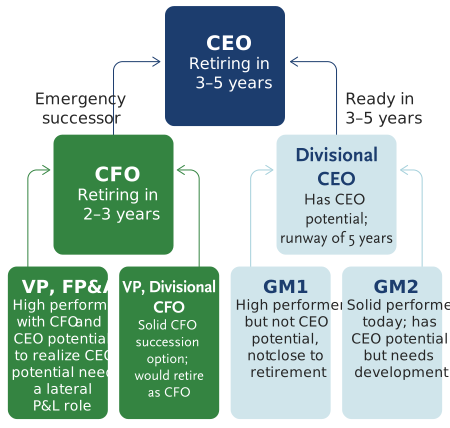
Chess-move exercises are easier when leaders have systematic visibility into the top talent across the enterprise. At Fortive, twice-annual talent reviews by the leadership team highlight high performers who are ready for new developmental opportunities, said Stacey Walker, former senior vice president and chief people officer. “We as a collective group talk about what we can do from a development standpoint. I might be struggling to craft a development move, but someone else may have a project that could provide the needed exposure or experience.”
In addition to actions by management, the board should have pipeline visibility for critical leadership positions, including updates on their development and personal interactions at board meetings or dinners. At Visa, Tullier and CEO Ryan McInerney present the board with highlights from the leadership team’s deep talent review during a two-hour session once a year. In addition, each nominating and governance committee meeting begins with a presentation by a member of the executive committee, who takes directors through their vision and strategy, team structure and high performers. “The board loves those discussions because they give directors a chance to see an executive in a different light, as a leader talking about their people, which is very insightful to the board,” Tullier said.
5. Have a rigorous system to identify, develop, deploy and showcase high-potential talent
While everyone wants “high-potential” leaders, few organizations have a truly objective methodology for measuring potential — and the stakes are high for being wrong. Most of us have seen someone who was “high potential” once and “just ok” when organizational circumstances changed. How does that happen when potential should be a stable indicator of future room to grow? Conversely, overlooked hi-pos can fly under the radar and miss important opportunities to develop toward C-suite leadership.
While everyone wants “high-potential” leaders, few organizations have a truly objective methodology for measuring potential — and the stakes are high for being wrong.
This matters because our research shows that enterprise leadership potential — defined at Spencer Stuart as one’s Executive Intelligence® — is a better predictor of C-suite success than prior experience in the role. Executive Intelligence reflects a person’s ability to exercise sound business and stakeholder judgment and decision-making even in unfamiliar situations and includes openness and flexibility, learning orientation and capacity to engender followership. In a study of S&P 500 CEOs, we found that first-time CEOs achieved higher performance over the course of their tenure on average than experienced CEOs. These agile thinkers tend to respond better to complexity and rapid change because they aren’t tied to past playbooks. Instead, they synthesize competing perspectives, guide teams through uncertainty and enhance the organization’s capacity to sustain transformation. This is often true for first-time CXOs, who face a huge learning curve to excel in a job that is likely much more complex than their prior roles.
Organizations can improve their ability to identify high-potential people through rigorous internal talent management that leverages HR analytics and psychometrics. They also can partner with well-respected leadership advisory firms steeped in both leadership assessment and executive talent pools who can provide objective reviews of leadership potential and help benchmark talent needs in the market.
But it’s not enough to discover high-potential future leaders; companies must turn that potential into C-suite readiness, and this takes time — upwards of a decade, if developing someone from middle management to CXO. Because much can change in that period, current CEOs and CHROs must be willing to invest in tomorrow’s talent without guaranteed outcomes.
In our experience, most companies could benefit from investing much more in the targeted development and monitoring of high-potential talent. This may start with an objective executive assessment to inform a thoughtful development plan. Most importantly, leadership must help ensure follow-through. Does the leader need an executive coach to activate the behavioral changes they identified on their plan? Do they need a board mentor or would membership in an external peer network provide critical perspectives? Is a 360-feedback refresh needed in 12–18 months to understand developmental progress, especially if they are being given a stretch assignment? Hi-pos and their leaders must work together to traverse the road from raw potential to C-suite readiness.
Assessments are so additive to gaining an early and objective view. They provide real data when we're discussing selection and development decisions.”
STACEY WALKER
FORMER SENIOR VICE PRESIDENT AND CHIEF PEOPLE OFFICER, FORTIVE
While they develop hi-pos, organizations also should be monitoring external talent pools. With a scan of the external talent market, organizations can be clear-eyed about the strengths and development gaps of internal talent. External benchmarking exercises also can surface exceptional talent, allowing companies to selectively make strategic hires that add external perspective and boost the bench. Hiring below the C-suite allows leaders time to learn the culture and different parts of the business, preparing them for future C-suite opportunities. This approach is less risky than hiring outside directly for a key C-suite role.
6. Make the hard decisions that put the organization’s needs first
Even the best succession plans can be derailed given the human factors at play. Organizations often hesitate to replace talent seen as loyal or hardworking but whose skills are less relevant for the future. These long-time leaders may be sitting in key roles, blocking next-generation talent from being promoted to those positions. Meanwhile, false narratives or quiet questions can color decisions about individuals’ suitability regarding potential moves. Too often, these questions — “Are we sure they are strategic enough?” — are thrown around absent a definition of strategic for that role or an actual assessment of the person’s ability. Especially when business conditions are uncertain, decision-makers become risk averse, and they make “safe” bets by selecting candidates with more experience or those who “fit the part.”
Advice for new CEOs: Start early and cast a wide net
If you are a new CEO, succession planning may feel like a medium- to long-term priority for your role and leadership team as you are focused on getting to know your board and establishing your strategy. Our research and work with thousands of new CEOs reinforce that high-performing CEOs use the earliest days of their tenure to build a robust top team around them and prioritize succession planning to support and amplify their leadership, address gaps in their skills or knowledge, and accelerate their agenda. Most new CEOs take too long to properly evaluate their team and act on talent, much less put succession planning into action. Our advice? Get to work immediately on your talent and succession agenda and don’t kick the can down the road. Here are our recommendations for moving fast and effectively on your team.
There is also the issue of well-accepted “criteria”: “The role has always sat in [location].” “We have always needed a [norm] in the position.” “We have always had a [role].” Many must-haves reflect historical patterns. With organizations changing fast due to AI and other trends, it is important to revisit longstanding requirements. This comes back to ensuring the CXO profile reflects the future business strategy before talking about individuals.
The CEO and CHRO must be clear-eyed about these challenges, putting the interests of the enterprise (which includes future talent) first, while being respectful to any individuals who are impacted short term. In our experience, this is one of the hardest things for most organizations to get right. It takes long-term thinking to see the mutual benefit that making those hard decisions today brings to the enterprise, and courage for leaders to follow through on those actions.
• • •
It’s now six months since that late night, and the CHRO in our opening story is feeling proud. The new CFO — who had been the internal frontrunner — just delivered a strong earnings call alongside the CEO, and the stock was up. The finance function was performing well.
How did the company get here? After learning about the CFO’s expedited departure, the CHRO and CEO had a fruitful conversation about what will be needed from the finance function and the key capabilities for operating in an uncertain, challenging and complex time.
They decided on a two-tracked approach that included a rigorous reassessment of the internal candidate to confirm they had the potential, followership and sufficient experience to stretch into the CFO role, as well as an external benchmarking exercise, which would both highlight external options and show how the internal candidate stacked up against best-in-class outside finance talent. To refresh the board’s knowledge of the candidate, whose development they had tracked as part of their long-term succession planning, the CEO and CHRO shared the findings of the updated assessment and benchmarking with the board, including detailed findings with the audit committee.
Ultimately, this work confirmed the internal successor was sufficiently developed, well aligned to the future CFO profile and, with the right support, could excel in the role. Because the CEO was experienced and mature, the board felt confident about the selection of a first-time CFO. A robust onboarding program, including executive coaching by the trusted leadership consultant who had been working with them, would further enhance their chances of success. The VP who thought they should have been promoted also went through an assessment refresh, receiving clear feedback on how to accelerate their development.
The CFO succession had some twists and turns, but so far, their new CFO was off to a great start. The CHRO and CEO — plus new CFO — were already back at work planning for CFO succession again.
Developing robust succession pipelines is harder but more important than ever. Leaders can set their organizations up for success by embracing a thoughtful process that is grounded in objective criteria and the company strategy, rigorously develops internal options and overcomes the common pitfalls.
